
Stand mixer power should be selected based on the complexity of your baking tasks, as wattage ratings from 250 to 1000 watts indicate motor strength for different applications. Lower wattage around 250 to 400 watts suffices for light tasks like whipping cream, while higher wattage above 500 watts is necessary for heavy doughs and prolonged mixing. Consider factors such as motor type, gearing, and your specific baking needs to determine the optimal power level, as wattage alone does not guarantee performance.
Picking a stand mixer can feel a little tricky, especially when you see all those different numbers for power.
You might wonder, how powerful should a stand mixer be for what you need? Don’t worry, it’s not as complicated as it sounds.
Key Takeaways
- Stand mixer wattage indicates motor strength for different tasks.
- Lower wattage is fine for simple tasks like whipping cream.
- Higher wattage is better for heavy doughs and long mixing.
- Consider your common baking needs when choosing power.
- Motor type and gearing also affect a mixer’s actual strength.
- Don’t just look at wattage; think about how you’ll use the mixer.
We’ll walk through it step by step so you can find the perfect mixer for your kitchen adventures. Get ready to make baking a breeze.
![How Powerful Should a Stand Mixer Be[1]](https://creativehouseblog.com/wp-content/uploads/2026/03/How_Powerful_Should_a_Stand_Mixer_Be1.jpg)
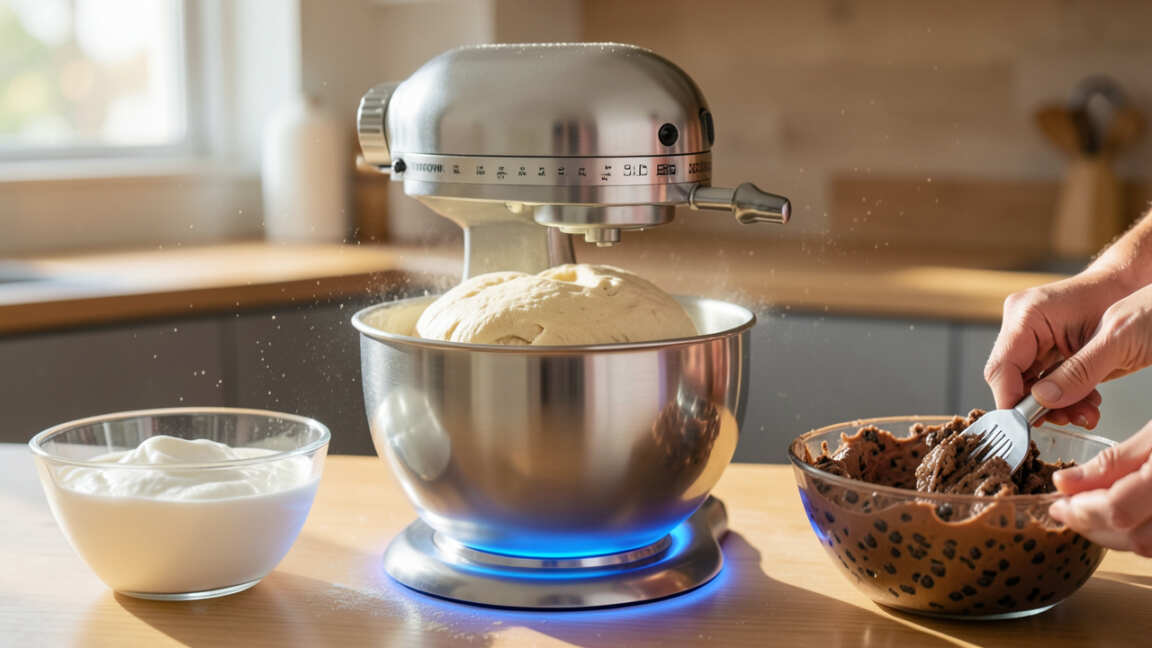
How Powerful Should a Stand Mixer Be
When you’re looking to buy a stand mixer, one of the first things you’ll notice is the power rating, usually measured in watts. This number can seem a bit confusing. You might think bigger numbers always mean better, but it’s not quite that simple.
Let’s break down what wattage really means for your stand mixer and how to pick the right one for your baking projects.
Understanding Wattage
Wattage tells you how much power the motor in your stand mixer can draw. A higher wattage generally means the motor is stronger. This is important because some baking tasks require more effort from the mixer than others.
For example, mixing a light cake batter uses less energy than kneading a thick bread dough.
What Wattage Means for Different Tasks
If you mostly bake cakes, cookies, and muffins, a mixer with a lower wattage might be perfectly fine. These tasks usually involve lighter batters and shorter mixing times. A mixer in the 250-400 watt range can often handle these everyday baking needs with ease.
However, if you plan on making a lot of bread, pasta dough, or other heavy doughs, you’ll want a more powerful mixer. Kneading dough requires the motor to work hard for longer periods. For these tougher jobs, a stand mixer with 500 watts or more is usually recommended.
This higher power helps prevent the motor from overheating and struggling.
More Than Just Wattage
While wattage is a good starting point, it’s not the only thing that determines a stand mixer’s strength. The design of the mixer, including the type of motor and its gearing, plays a big role too.
Motor Types
There are two main types of motors you’ll find in stand mixers:
- Direct Drive Motors: These motors connect directly to the mixer head. They tend to be more energy-efficient and quieter. They can often handle tougher jobs even with a slightly lower wattage rating because the power is transferred directly.
- Belt-Driven Motors: These use a belt system to transfer power from the motor to the beaters. They can sometimes be noisier and less efficient. They might require a higher wattage to achieve the same level of power as a direct drive.
Gearing and Durability
The gears inside the mixer also matter. Metal gears are generally more durable and can withstand more strain than plastic gears. A mixer with robust metal gearing, combined with a good motor, will perform better and last longer, especially when you’re tackling demanding recipes.
How to Choose the Right Power Level
To figure out how powerful your stand mixer should be, think about what you love to bake most often.
Consider Your Baking Habits
Ask yourself these questions:
- What types of recipes do I make most often?
- Do I bake a lot of bread or pizza dough?
- Do I only bake light cakes and cookies?
- How often will I be using the stand mixer?
If your answer leans towards heavy doughs and frequent use, aim for a mixer with at least 500 watts. If your baking is lighter and less frequent, you can probably get by with something in the 300-450 watt range.
Wattage Ranges and What They Mean
Here’s a general guide to stand mixer wattage:
| Wattage Range | Best For | Considerations |
|---|---|---|
| 250-400 Watts | Light mixing, whipping cream, cookie dough, cake batter | Good for beginners or occasional bakers. May struggle with dense doughs. |
| 400-500 Watts | All of the above, plus thicker cookie doughs and lighter bread doughs | A good middle ground for many home bakers. Offers more versatility. |
| 500+ Watts | Heavy bread doughs, pasta dough, large batches, frequent use | Ideal for serious bakers and those who make tough doughs regularly. Built for power and endurance. |
When More Power Isn’t Always Better
It’s true that higher wattage often means more power. However, a very high wattage isn’t always necessary, and it might even be overkill for some users. A mixer that’s too powerful for light tasks might also be louder or heavier than you need.
Plus, you can often find excellent performance from a well-designed mixer with a moderate wattage.
The Importance of Gearing and Design
Remember that a mixer’s gearing and overall construction can make a big difference. A 400-watt mixer with excellent metal gears might outperform a 600-watt mixer with cheap plastic gears for tough jobs. Look for mixers that are known for their durability and smooth operation.
Budget and Brand Considerations
Stand mixer prices vary a lot. Generally, more powerful mixers with higher wattage and better build quality will cost more. Decide on your budget first, and then see what the best option is within that range.
Well-known brands often have good warranties and customer support, which is a plus for any appliance.
Research and Reviews
Before you buy, read reviews from other users. They can give you real-world insights into how a mixer performs with different types of ingredients and how well it holds up over time. Pay attention to comments about the mixer’s ability to handle heavy loads.
Specific Baking Needs
Think about the specific things you want to make.
Bread Making
If you dream of homemade sourdough or artisan bread, you absolutely need a powerful mixer. Kneading bread dough puts a lot of stress on the motor. A mixer with at least 500-600 watts and strong metal gears will make this task much easier and prevent the mixer from overheating.
Pastry and Cakes
For flaky pastries or light and airy cakes, you don’t need as much power. A mixer in the 300-450 watt range is usually sufficient. The key here is often the ability to mix at different speeds, including a slow speed for incorporating ingredients without overmixing.
Large Batches
If you often bake for parties or make large quantities of food, you’ll want a mixer that can handle bigger bowls and more ingredients at once. Powerful mixers are often designed with larger capacities and stronger motors to cope with these bigger jobs.
FAQ Of How Powerful Should a Stand Mixer Be
Question: Is a 300 watt stand mixer powerful enough for most home bakers?
Answer: For many home bakers who focus on cakes, cookies, and lighter batters, a 300-watt stand mixer can be sufficient. It might struggle with very dense bread doughs or large batches.
Question: What is the minimum wattage recommended for making bread?
Answer: For regularly making bread dough, it’s recommended to look for stand mixers with at least 500 watts. Higher wattage helps the motor handle the strain of kneading.
Question: Does a higher wattage always mean a better stand mixer?
Answer: Not necessarily. While wattage indicates motor power, the quality of the gears, the motor type (direct drive vs. belt-driven), and the overall build also contribute to performance and durability.
Question: How can I tell if a stand mixer is powerful enough without just looking at watts?
Answer: Check reviews for comments on how the mixer handles heavy doughs, listen for motor strain, and look for features like metal gears. A good warranty can also indicate manufacturer confidence in the product’s durability.
Question: Can a lower wattage mixer be improved with better attachments?
Answer: Attachments like dough hooks are designed to work with the mixer’s power. While attachments can make tasks easier, they won’t fundamentally increase the motor’s power. A weak motor will still struggle with very heavy doughs regardless of the attachment.
Final Thoughts
Choosing the right stand mixer power is about matching it to your baking habits. For light tasks, less power is fine. For heavy doughs, more power is better.
Think about what you bake most and pick a mixer that fits those needs. A good mixer makes baking more enjoyable and less work.

![How to Flush Water Heater Prevent Sediment Build[1]](https://creativehouseblog.com/wp-content/uploads/2026/05/How_to_Flush_Water_Heater_Prevent_Sediment_Build1-768x403.jpg)
![10 Foods You Can Cook In A Deep Fryer (Beyond Fries)[1]](https://creativehouseblog.com/wp-content/uploads/2026/04/10_Foods_You_Can_Cook_In_A_Deep_Fryer_Beyond_Fries1-768x448.jpg)
![Troubleshooting Common Bread Maker Problems[1]](https://creativehouseblog.com/wp-content/uploads/2026/03/Troubleshooting_Common_Bread_Maker_Problems1-768x448.jpg)
![6 Reasons Your Garbage Disposal Is Smelling Bad[1]](https://creativehouseblog.com/wp-content/uploads/2026/04/6_Reasons_Your_Garbage_Disposal_Is_Smelling_Bad1-768x448.jpg)
![Are Induction Cooktops Energy Efficient[1]](https://creativehouseblog.com/wp-content/uploads/2026/03/Are_Induction_Cooktops_Energy_Efficient1-768x448.jpg)
![What to Do When Your Heating System Breaks in Winter[1]](https://creativehouseblog.com/wp-content/uploads/2026/05/What_to_Do_When_Your_Heating_System_Breaks_in_Winter1-768x403.jpg)