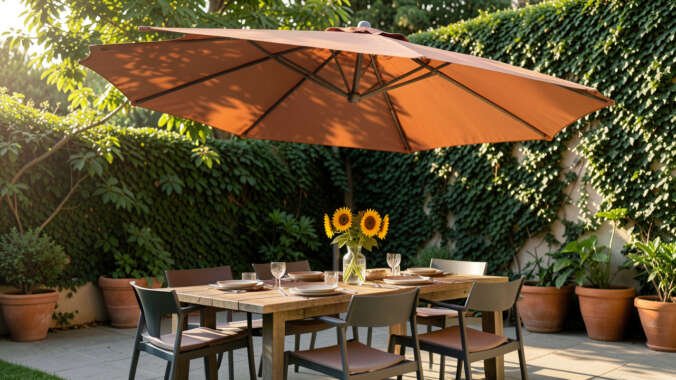
The correct patio umbrella size for a dining area extends at least two feet beyond each side of the table, requiring a nine-foot round umbrella for a 48-inch round table and an eight-by-ten-foot rectangular umbrella for a four-foot rectangular table. This overhang ensures seated diners receive full shade coverage, preventing sun exposure on half the table. To determine your exact size, measure your table’s width or diameter and add four to five feet, then choose an umbrella shape that matches your table’s shape for balanced protection.
You bring home a beautiful patio dining set, then realize your umbrella leaves half the table in the sun. This frustrating mistake happens when you pick the wrong size. This guide shows you exactly what size patio umbrella you need for your patio dining area based on table dimensions, shape, and setup.
Quick Verdict: In short, a patio umbrella should extend at least 2 feet beyond each side of your dining table on all sides. For a 48-inch round table, you need a 9-foot umbrella. For a 4-foot rectangular table, an 8-foot by 10-foot rectangular umbrella works best. Always measure your table and add 4-5 feet to the diameter or width.
The right umbrella size protects your guests from sun and light rain. It also keeps your patio looking balanced and intentional. Let’s break down the math.
Key Takeaways
- A patio umbrella must extend at least 2 feet beyond the table edges on all sides to provide effective shade for seated diners.
- Round tables need a round umbrella with a diameter at least 4 feet larger than the table diameter.
- Rectangular tables pair best with rectangular or square umbrellas that cover the full length and width of the table.
- Umbrellas over 11 feet typically require a heavier base or a built-in weighted stand to remain stable in windy conditions.
- Using multiple umbrellas or a cantilever offset model can solve shade problems for long or irregularly shaped tables.
What Is the Correct Umbrella Size for Your Table?
Most dining tables are either round or rectangular. The rule is consistent: your umbrella should overhang the table by at least 2 feet on every side. This gives each seated person enough shade and prevents sun from hitting the table surface.
Here is the simple calculation for round tables:
- Measure the diameter of your table in inches.
- Add 48 inches (2 feet per side x 2 sides).
- Convert to feet by dividing by 12.
- Choose an umbrella with a diameter at or above that number.
For example, a 48-inch round table needs a 96-inch umbrella, which is exactly 8 feet. But since standard sizes jump to 9 feet, choose the 9-foot umbrella for better coverage.
For rectangular tables, measure the length and width separately. Add 4 feet to both dimensions. Then look for a rectangular umbrella that matches or exceeds those numbers. A 6-foot by 4-foot table needs an umbrella at least 10 feet long and 8 feet wide.
Important: Do not forget the umbrella pole position. A center-hole table places the pole directly in the middle, so the umbrella covers the entire table equally. For side-mounted or offset stands, the coverage shifts. You may need a larger umbrella to compensate for the offset.
According to, proper shading can reduce surface temperatures on outdoor furniture by as much as 20 degrees Fahrenheit. This makes choosing the right umbrella not just a comfort issue, but a safety one too.
How Does Table Shape Affect Umbrella Choice?
Umbrella shape should mirror your table shape for maximum coverage and visual harmony. Round umbrellas work best with round tables. Rectangular umbrellas fit rectangular tables. Square umbrellas suit square tables.
Round umbrellas are the most common and most affordable. They provide even shade in all directions, which makes them ideal for center-pole round tables. Sizes range from 6 feet to 13 feet in diameter.
Rectangular and square umbrellas cover long tables more efficiently. A 6-foot by 10-foot rectangular umbrella can protect a full rectangular table without wasting shade on empty air. Many models come with a standard 1.5-inch pole that fits most table bases.
Offset or cantilever umbrellas have the pole on the side. This lets you position the canopy over the table without a center pole blocking views or legroom. Offset umbrellas often come in larger sizes, up to 11 feet by 11 feet square.
According to, offset umbrellas can be up to 30 percent more expensive than center-pole models but offer greater flexibility for large or custom table arrangements.
What Size Umbrella Do You Need for a 4-Top Table?
A standard 4-person table is usually 36 to 48 inches wide. For a round 48-inch table, a 9-foot umbrella provides the recommended 2-foot overhang. For a square 48-inch table, a 9-foot square umbrella works perfectly.
If your 4-person table is rectangular, around 48 inches by 36 inches, you need a rectangular umbrella at least 8 feet long and 7 feet wide. Many manufacturers offer 8-foot by 7-foot or 9-foot by 6-foot options.
Here is a quick reference table for common table sizes:
| Table Type | Table Dimensions | Recommended Umbrella Size | Umbrella Shape |
|---|---|---|---|
| Round 4-seat | 48-inch diameter | 9-foot diameter | Round |
| Square 4-seat | 48-inch x 48-inch | 8-foot x 8-foot (or 9-foot square) | Square |
| Rectangular 4-seat | 48-inch x 36-inch | 8-foot x 7-foot (or 9-foot x 6-foot) | Rectangular |
| Round 6-seat | 60-inch diameter | 10-foot or 11-foot diameter | Round |
| Rectangular 6-seat | 72-inch x 36-inch | 10-foot x 7-foot (or 11-foot x 8-foot) | Rectangular |
| Rectangular 8-seat | 96-inch x 42-inch | 11-foot x 8-foot (or use two 6-foot round umbrellas) | Rectangular or multiple |
Notice that for very long tables (8 feet or longer), a single umbrella may not be practical. Two smaller umbrellas can cover the entire table without leaving gaps. This also allows independent tilt for changing sun angles.
Tip: When using two umbrellas on one table, overlap the canopy edges by at least 12 inches. This prevents a sun stripe running down the middle of the table. Use matching or complementary colors for a coordinated look.
What About Umbrella Height and Cantilever Options?
The height of your umbrella matters too. Standard center-pole umbrellas have a pole that fits through a table hole or into a separate base. The canopy should sit about 7 to 8 feet above the ground. This gives enough clearance for average-height people to stand and move around.
Cantilever umbrellas use an offset arm and a heavy base. They allow the canopy to hover directly over the table without a center pole. The umbrella arm can be rotated to follow the sun. Cantilever sizes usually range from 8 feet by 8 feet up to 11 feet by 11 feet.
According to, cantilever umbrellas are often chosen for tables that are not center-drilled or for seating areas where a center pole would be in the way. The trade-off is cost: cantilever models average 50 to 100 percent more than a standard center-pole umbrella of equivalent canopy size.
The main advantage of a cantilever umbrella for dining areas is flexibility. You can place the base several feet away from the table and angle the canopy to cover exactly the area you want. This can allow a slightly smaller umbrella to work effectively because you can position it with less wasted shade.
Who Needs a Large Umbrella (11 Feet and Up)?
Large umbrellas, 11 feet in diameter or more, are designed for extended dining tables seating 8 to 12 people. They also work for groups that want a generous overhang to shade nearby serving carts or side chairs.
Before buying a 12-foot or 13-foot umbrella, consider these factors:
- The base must be heavy enough to counterbalance the large canopy. A 12-foot umbrella in a slight breeze can tip over if the base is too light.
- Large umbrellas require a sturdy pole. Look for poles made of aluminum or hardwood with a diameter of at least 1.5 inches.
- Wind vents in the canopy help reduce pressure and prevent the umbrella from acting like a sail.
- If your table has a center hole, verify the hole diameter accommodates the pole size (often 1.5 or 2 inches).
The recommends checking the umbrella’s wind rating. Many large umbrellas are rated for winds up to 15 mph. In gusty areas, close the umbrella when not in use to extend its life.
Warning: Do not use a 12-foot umbrella on a flimsy plastic base. Even with a 50-pound base, a gust of wind can knock it over and damage your table or hurt someone. Use a base rated for at least 75 pounds for umbrellas 11 feet and above.
How to Measure Your Patio Dining Area Correctly
Measuring seems simple, but many people forget to account for the umbrella pole offset or the table thickness. Follow these steps to get an accurate measurement for what size patio umbrella you need.
- Measure the tabletop width and length in inches. For round tables, measure the diameter across the center.
- Add 48 inches to both dimensions (24 inches overhang per side). This gives you the minimum canopy dimensions.
- If you plan to use the umbrella with the pole off-center (e.g., through a hole that is not dead center, or with a side base), add an extra 12 inches to the short side. This compensates for the offset.
- Check the umbrella’s actual canopy size in the product description. Some brands list the diameter of the canopy when fully opened, but a few measure the rib length. Rib length is typically half the diameter.
- Make sure the base footprint does not extend into walking space around the table. A cantilever base, for example, may need a 2-foot by 3-foot area.
Many online retailers provide sizing guides. Use these for reference but verify with your own measurements.
What Are the Best Umbrella Shapes for Different Patio Layouts?
Not all umbrellas are round or rectangular. Some specialty shapes work better for specific layouts.
- Half-round umbrellas: Designed for tables pushed against a wall or railing. They provide shade for the dining area without leaving unused canopy over the wall.
- Octagonal umbrellas: Offer more shade area than a round umbrella of the same diameter because of the extra fabric. They often look more decorative.
- Square umbrellas: Excellent for square tables. They can also tilt to cover rectangular tables if you align the canopy diagonally.
- Oval umbrellas: Rare but available from some custom patio furniture brands. They match oval tables beautifully.
According to, rectangular umbrellas are the fastest-growing segment in the outdoor umbrella market, driven by the popularity of rectangular dining tables.
Common Myths vs Facts About Patio Umbrella Sizing
Many people misunderstand how umbrella size relates to table size. Here are three myths and the real facts.
Myth 1: A 7-foot umbrella works for a 48-inch table.
Fact: A 7-foot umbrella gives only a 15-inch overhang on each side of a 48-inch table. That is not enough to shade full dinner plates and seated guests. A 9-foot umbrella is the correct minimum.
Myth 2: You can use a round umbrella on a rectangular table.
Fact: You can, but you will waste shade at the corners. A round umbrella on a rectangular table leaves the ends and corners exposed. A rectangular umbrella fits better and covers the entire table surface.
Myth 3: A larger umbrella gives better shade.
Fact: A larger umbrella can cause wind stability issues and may not fit your patio space. The right umbrella matches your table dimensions. Oversizing by more than 4 feet in diameter is unnecessary and can look awkward.
Frequently Asked Questions
What size umbrella do I need for a 72-inch round table?
For a 72-inch (6-foot) round table, you need at least a 10-foot round umbrella. The calculation is 72 inches plus 48 inches = 120 inches, which is exactly 10 feet. A 12-foot round umbrella gives even more generous shade.
Can I use a 9-foot umbrella on a 36-inch table?
Yes, a 9-foot umbrella provides a 30-inch overhang on each side of a 36-inch table. That is more than the recommended 2 feet, so it works well. Just ensure the pole and base fit the table and that the canopy does not hit nearby walls or plants.
How do I know if my table base is strong enough for a large umbrella?
Check the maximum recommended canopy size for your base. Most universal bases indicate a weight capacity in pounds. For a 9-foot umbrella, use at least 40 pounds of base weight. For 11-foot and above, use 75 pounds or more.
What is the best umbrella type for a corner dining setup?
A half-round or quarter-round umbrella is best for corner dining. These mount to a wall or railing and shade the table without taking up floor space. Alternatively, a small cantilever umbrella works if you have side clearance.
Should I get an umbrella with a tilt feature?
Yes, a tilt feature is highly recommended. It allows you to adjust the canopy angle as the sun moves. This keeps your dining area shaded longer. Look for a tilt mechanism that is easy to operate, such as a push-button or crank system.
Pro Tips for Buying the Right Patio Umbrella
Choose the right material for your climate. Standard polyester canopies fade in intense sun after two seasons. Solution-dyed acrylic (like Sunbrella fabric) resists fading and mildew for up to five years. states their fabric is rated for 500 hours of UV exposure without significant fading.
Check the umbrella pole and ribs. Aluminum poles are lightweight and rust-resistant. Wood poles (teak or eucalyptus) look classic but are heavier and require annual sealing to prevent cracking. Ribs should be made of steel or fiberglass; fiberglass ribs flex in wind without breaking.
Consider the base type. Market umbrellas require a separate base, while some table designs include a built-in base. If you buy a base separately, match the base weight to the umbrella size:
- 7-8 foot umbrella: 35-40 pound base
- 9-10 foot umbrella: 50-60 pound base
- 11-13 foot umbrella: 75-100 pound base
Look for a warranty. Major brands offer 1 to 5 years on the frame and canopy. A longer warranty typically indicates higher quality materials.
Tip: If your table is an odd size, use an online umbrella size calculator. Many patio furniture retailers have these on their product pages. Input your table dimensions and it recommends a size. Always round up to the next standard size for safety.
Resources and Tools
- PatioLiving Umbrella Size Guide – Interactive tool to calculate the right umbrella size based on table dimensions.
- Wayfair Umbrella Buying Guide – Detailed article covering materials, shapes, and features.
- Consumer Reports Outdoor Furniture Ratings – Independent reviews of umbrella durability and performance.
- Sunbrella Fabric Performance Data – Information on UV resistance, water repellency, and cleaning.
Final Thoughts
Getting the right patio umbrella size means measuring your table and adding at least 4 feet to the diameter or width. Match the umbrella shape to your table shape for the most efficient coverage. Consider cantilever options for offset tables or long rectangular setups. With the right size and a strong base, your outdoor dining area stays comfortable all season.