
Many people wonder about How Air Fryers Work. They see crispy food and think it’s magic. It can seem a bit confusing at first.
But it’s actually quite simple! We’ll break it down step by step. You’ll see just how easy it is to make delicious, healthier meals.
Get ready to understand your air fryer like never before.
Key Takeaways
- Air fryers use hot air to cook food.
- They mimic deep frying with less oil.
- A heating element and fan are key components.
- Convection cooking makes food crispy.
- Air fryers are versatile for many foods.
- They offer a healthier way to enjoy fried textures.
![How Air Fryers Work Simplified[1]](https://creativehouseblog.com/wp-content/uploads/2026/03/How_Air_Fryers_Work_Simplified1.jpg)
How Air Fryers Work Explained
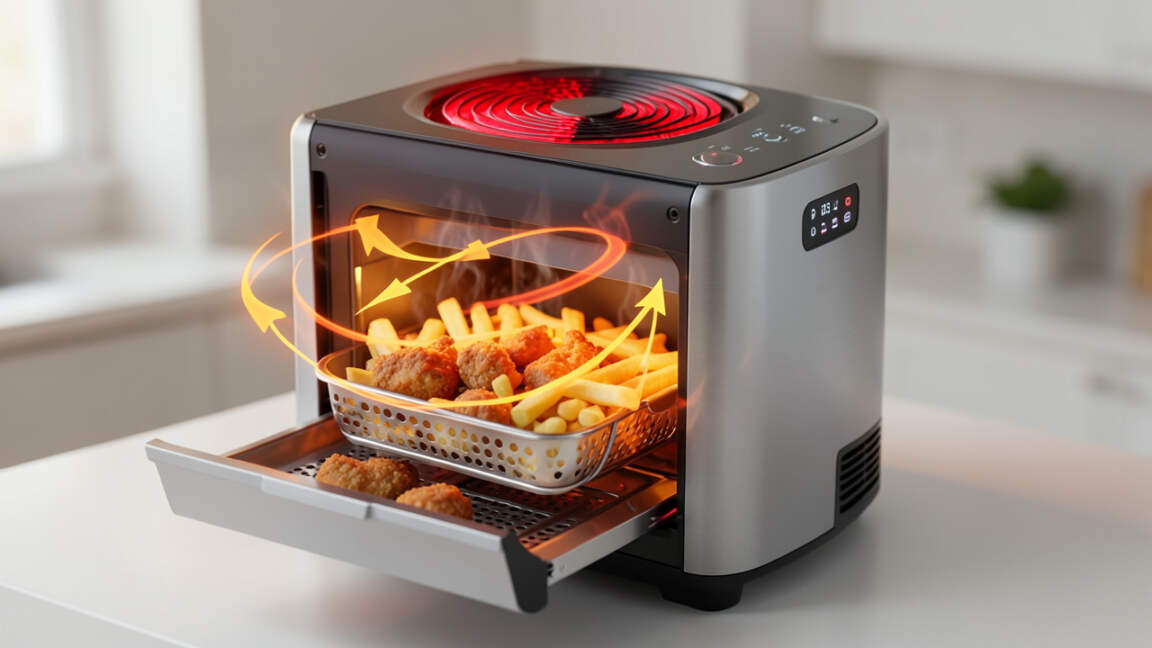
Air fryers are kitchen appliances that make food crispy and delicious. They do this using a cooking method that’s similar to how ovens work, but much faster. The main idea is to circulate very hot air around your food at high speed.
This hot air is what makes your fries, chicken wings, and other treats turn golden brown and crunchy. You get that satisfying fried texture without all the oil you’d need for deep frying. This makes them a popular choice for anyone looking for healthier versions of their favorite fried foods.
The Basic Design of an Air Fryer
Every air fryer has a few main parts that work together to cook your food. The most important parts are the heating element and the fan. The heating element is usually at the top of the air fryer.
It gets very hot, just like the heating coils in your oven. This is where the heat comes from to cook your food.
Right next to the heating element is a powerful fan. This fan is the real star of the show. Its job is to blow the hot air all around the cooking basket.
Think of it like a tiny, super-fast convection oven. The fan pushes the hot air around the food quickly and evenly. This rapid movement of air is what gives your food its crispy outer layer.
Most air fryers also have a cooking basket or tray. This is where you place your food. It’s usually designed with holes or a mesh bottom.
This design allows the hot air to flow freely around all sides of the food. This ensures that every piece gets cooked evenly and gets that desirable crispiness.
The Science Behind the Crisp
So, how does all this hot air make your food crispy? It’s all about a process called convection. In a regular oven, heat transfers to food mainly through radiation and some natural convection.
However, air fryers use forced convection. This means the fan actively moves the hot air, creating a powerful current.
When this superheated air hits the surface of your food, it causes the moisture on the outside to evaporate very quickly. This rapid drying effect creates a crispy crust. For foods with a little bit of oil, like fries or chicken pieces, the heat also helps to cook the oil and make the surface even crispier.
It’s similar to how deep frying works, but with much less oil.
The high temperature and constant air circulation work together. They cook the food through while also browning and crisping the exterior. This is why air-fried foods often have a texture that’s very close to deep-fried items, but with significantly less fat and calories.
It’s a smart way to enjoy those familiar flavors and textures.
The Role of Hot Air Circulation
The key to an air fryer’s success is its ability to circulate hot air rapidly and evenly. Unlike a conventional oven, where hot air can sometimes be uneven, an air fryer is designed to create a vortex of heat. The fan pulls air in, heats it up, and then blasts it down and around the food in the basket.
This constant flow ensures that all parts of the food are exposed to the hot air. Imagine a gentle breeze turning into a strong gust of wind, but with heat. This powerful airflow penetrates the food’s surface, leading to quick cooking and even crisping.
There are no “dead spots” where food might be soggy.
Even if you don’t toss or stir your food, the air fryer works hard to cook it uniformly. This is why you often don’t need to flip smaller items. The continuous movement of air does most of the work for you.
This efficiency is a big part of why air fryers are so popular for quick meals.
Comparing Air Fryers to Other Cooking Methods
It’s helpful to see how air fryers stack up against other common ways of cooking. Deep frying uses a lot of oil. Food is submerged in hot oil, which makes it very crispy but also adds a lot of fat and calories.
Air frying uses only a small amount of oil, or sometimes none at all, for a similar crispy result.
Baking in a conventional oven also uses hot air, but it’s usually less intense and slower. Air fryers have a more concentrated heat and faster air circulation. This means they cook food much quicker and create a crispier texture than most ovens.
They are also much faster to preheat than a full-sized oven.
Pan-frying or sautéing involves cooking food in a small amount of oil in a pan. This can create a nice sear, but it doesn’t always result in the all-around crispiness that an air fryer can achieve. Plus, you often have to stir or flip the food more frequently.
Microwaves cook food using electromagnetic waves that excite water molecules. This heats food quickly but doesn’t create any crispiness at all. Air fryers, on the other hand, are all about achieving that desirable crispy exterior.
Tips for Using Your Air Fryer Effectively
To get the best results from your air fryer, there are a few simple tips to keep in mind. First, don’t overcrowd the basket. The hot air needs space to circulate around the food.
If you pack it too full, the food will steam instead of crisp. Cook in batches if needed.
Second, a little bit of oil can go a long way. For foods like fries or chicken wings, tossing them with a tablespoon or two of oil before air frying helps them get extra crispy. You can use a spray oil for a lighter coating.
However, many foods, like frozen items or things with their own fat, don’t need any added oil.
Third, shake or toss your food halfway through cooking. While the air circulation is great, giving your food a little nudge ensures even cooking and crisping on all sides. This is especially true for smaller items like fries or vegetables.
Fourth, preheating your air fryer can help. Like an oven, preheating ensures that the air is at the correct temperature from the moment you add your food. Most recipes will suggest a preheat time, usually around 3-5 minutes.
Finally, experiment with different foods! Air fryers are not just for fries. You can cook vegetables, chicken, fish, snacks, and even desserts.
Learning what works best for different ingredients will help you make the most of your appliance.
FAQ Of How Air Fryers Work Simplified
Question: Do air fryers use a lot of electricity
Answer: Air fryers generally use less electricity than a full-sized oven because they are smaller and cook food much faster. They are quite efficient for the results they deliver.
Question: Can I put aluminum foil in my air fryer
Answer: Yes, you can use aluminum foil in your air fryer, but make sure it does not block the airflow. Place it at the bottom of the basket or tray, and never cover the entire surface, as this can prevent hot air circulation.
Question: How do I clean my air fryer
Answer: Most air fryer baskets and trays are dishwasher safe. For manual cleaning, use warm, soapy water and a non-abrasive sponge. Make sure to unplug and let the air fryer cool completely before cleaning.
Question: What is the main difference between an air fryer and a convection oven
Answer: The main difference is that air fryers have a much more powerful fan and a more confined space, which leads to faster cooking and crispier results due to more intense forced convection compared to a typical convection oven.
Question: Can I cook raw meat in an air fryer
Answer: Yes, you can cook raw meat in an air fryer. It’s a great way to get crispy chicken wings or juicy burgers. Just make sure the meat is cooked to the proper internal temperature for safety.

Final Thoughts
Air fryers cook food by circulating very hot air around it at high speed. This is called forced convection. A fan blows hot air from a heating element, making food crispy.
It’s like a mini convection oven. This method uses less oil than deep frying. You get crunchy foods with fewer calories.
Experimenting with different recipes is fun. Enjoy your crispy meals!

![How To Spot Slow Leaks At Home Before They Grow[1]](https://creativehouseblog.com/wp-content/uploads/2026/05/How_To_Spot_Slow_Leaks_At_Home_Before_They_Grow1-768x403.jpg)
![How to Maintain Window Seals for Fewer Draughts and Damp[1]](https://creativehouseblog.com/wp-content/uploads/2026/05/How_to_Maintain_Window_Seals_for_Fewer_Draughts_and_Damp1-768x403.jpg)
![7 Sous Vide Mistakes Beginners Should Avoid[1]](https://creativehouseblog.com/wp-content/uploads/2026/04/7_Sous_Vide_Mistakes_Beginners_Should_Avoid1-768x448.jpg)
![Air Fryer Airflow For Better Cooking[1]](https://creativehouseblog.com/wp-content/uploads/2026/03/Air_Fryer_Airflow_For_Better_Cooking1-768x448.jpg)
![How to Reduce the Risk of Electrical Fires at Home[1]](https://creativehouseblog.com/wp-content/uploads/2026/05/How_to_Reduce_the_Risk_of_Electrical_Fires_at_Home1-768x403.jpg)