A cantilever umbrella is worth buying for a patio dining area when flexible shade over a large table is needed without a center pole obstructing seats or sightlines. The offset design enables 360-degree rotation and tilt for all-day sun control, but wind stability demands a base weighing at least 100 pounds for a 10-foot canopy. Investment typically ranges from $300 to $1,500 for quality, plus $100 to $300 for a base, making it ideal for rectangular tables seating six or more.
A cantilever umbrella blocks the sun from above without a center pole blocking your view. This guide helps you decide if a cantilever umbrella is worth the investment for your patio dining setup.
Simply put, a cantilever umbrella is worth buying when you want flexible shade over a dining table without a pole in the way. The offset design lets you position the canopy exactly where you need it. For large tables or sunny patios, it provides better coverage than a standard center-pole umbrella.
Key Takeaways
- A cantilever umbrella uses an offset pole and weighted base to shade your dining area without a center post blocking seats or sightlines at the table.
- The canopy rotates a full 360 degrees and tilts to block sun from any angle, giving you all-day shade control throughout the day.
- You should expect to invest between $300 and $1,500 for a quality cantilever umbrella, plus $100 to $300 for a suitable base that provides adequate weight.
- Wind stability is the biggest challenge with this design – you need a base weighing at least 100 pounds for a 10-foot canopy to prevent tipping in moderate wind.
- For rectangular dining tables seating six or more people, a cantilever umbrella offers superior coverage compared to a traditional center-pole model.
What Is a Cantilever Umbrella?
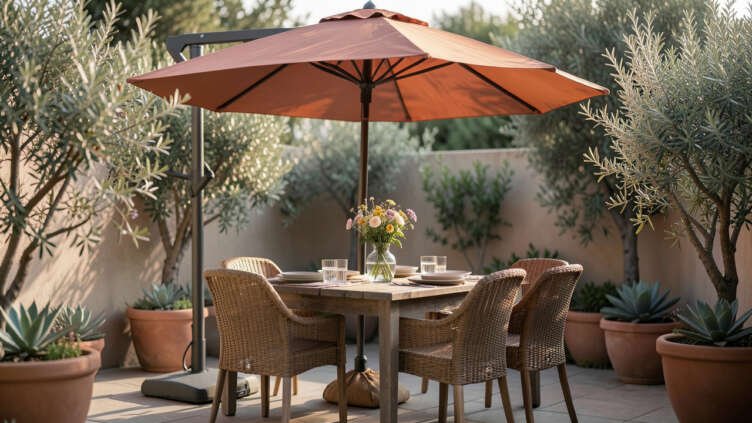
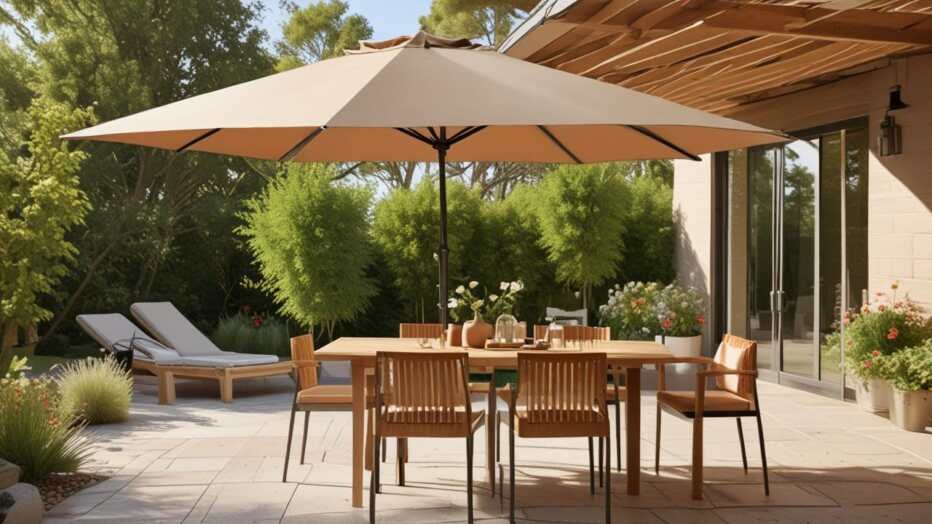
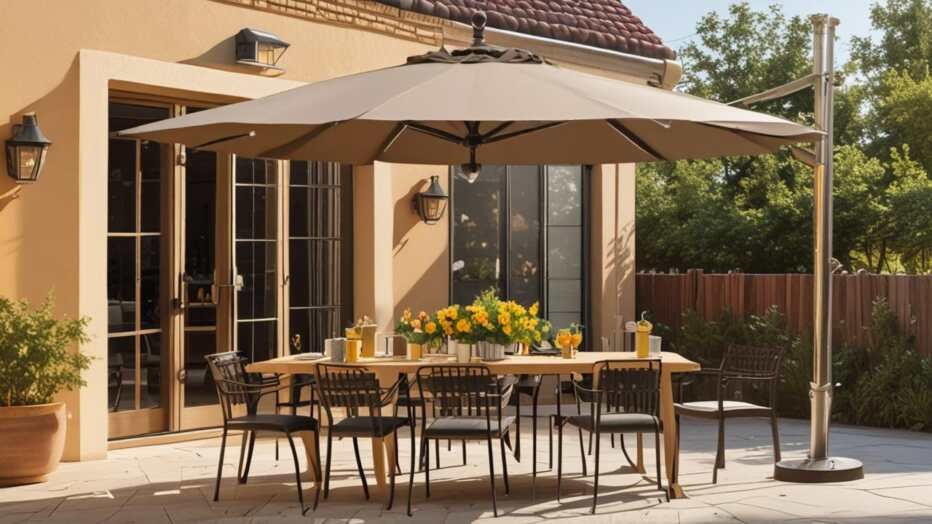
A cantilever umbrella is a shade structure with its support pole placed at the side rather than through the center of the canopy. The pole connects to an arm that extends outward, letting the canopy float above your seating area without obstruction. This offset design is what makes it different from a standard patio umbrella.
The umbrella consists of four main parts: the base, the pole, the arm, and the canopy. The base sits off to one side and holds the weight that keeps everything stable. The pole rises vertically and connects to a horizontal arm that reaches over your table. The canopy attaches to the arm and provides the actual shade for the dining area below.
Most cantilever umbrellas use a crank system to open and close the canopy. Many include a tilt mechanism that lets you angle the canopy as the sun moves across the sky. Higher-end models offer 360-degree rotation of the arm around the pole, giving you full control over where the shade falls at any time of day.
The cantilever umbrella design solves a common problem: the center pole that blocks conversation and limits seating arrangements. With no pole at the table, you can place chairs anywhere and everyone can reach the table without obstruction. This makes it a popular choice for dining areas where social interaction and clear sightlines matter most.
How Does a Cantilever Umbrella Work?
The cantilever system uses a counterbalance principle to stay upright. The heavy base and the lower portion of the pole act as a counterweight to the canopy that extends outward. When the canopy is fully open and angled, the weight distribution keeps the umbrella stable and balanced.
Most models use a cross-base design that allows the arm to rotate around the pole. You turn the handle or push the arm to reposition the canopy where you need it. Some umbrellas use a push-button rotation lock that clicks into place at set intervals. Others use a continuous rotation system with a locking collar for smooth adjustment.
Tip: Look for a cantilever umbrella with a wind vent in the canopy. The vent allows air to pass through, reducing lift and making the umbrella more stable in breezy conditions.
The crank mechanism is typically located on the pole at waist height. You turn the crank to open the umbrella, and a system of ribs and spokes extends the canopy outward. To close it, you crank in the opposite direction. This system is similar to a standard umbrella but must handle the additional leverage of the offset design with more durable components.
Tilt mechanisms vary by model and price point. Some use a simple push-button that lets you change the angle of the canopy in seconds. Others use a second crank or a lever system for finer control. The ability to tilt is important because the sun changes position throughout the day. Without tilt, you would need to rotate the entire arm to follow the sun across the sky.
Pros and Cons of Cantilever Umbrellas
Advantages
- No center pole – You get full use of your dining table without a pole blocking seats or interrupting sightlines during meals and conversations.
- Flexible positioning – The canopy rotates 360 degrees and tilts to shade your table from morning through late afternoon with minimal effort.
- Better coverage for large tables – A 10-foot or 11-foot cantilever canopy can shade an entire 6-to-8-person dining table with room to spare.
- Clean aesthetic – The offset design looks modern and keeps the visual focus on your table and seating arrangement rather than a center pole.
- Multi-functional use – You can position the shade over the table during meals and move it to cover loungers or a grill station later in the day.
Disadvantages
- Higher cost – A quality cantilever umbrella costs $500 to $1,500, compared to $100 to $400 for a standard center-pole umbrella of similar quality.
- Requires a heavy base – You need 100 to 200 pounds of base weight to keep the umbrella stable in moderate wind conditions.
- Takes up more space – The base and pole extend beyond the canopy, requiring a larger footprint than a traditional center-pole umbrella.
- Less stable in wind – The offset design creates more leverage, making the umbrella more prone to tipping than a standard umbrella in gusty conditions.
- More complex mechanism – More moving parts means more components that can break or need adjustment over the life of the umbrella.
Quick Comparison: Cantilever vs. Standard Patio Umbrella
| Feature | Cantilever Umbrella | Standard Umbrella |
|---|---|---|
| Typical cost | $300 – $1,500 | $100 – $400 |
| Base weight needed | 100 – 200 pounds | 30 – 60 pounds |
| Canopy sizes | 8 ft – 13 ft diameter | 6 ft – 11 ft diameter |
| Pole obstruction | None at table | Center pole at table |
| Rotation range | 360 degrees | 360 degrees (pole) |
| Wind resistance | Lower (more leverage) | Higher (lower profile) |
| Space footprint | Larger (base offset) | Smaller (pole centered) |
According to, cantilever umbrellas with cross-bases and properly weighted supports perform best in real-world conditions. Their research indicates that spending above $500 typically gets you a frame that lasts five years or more with proper care and regular maintenance.
Costs and Investment
A cantilever umbrella requires a bigger upfront investment than a standard patio umbrella. Here is what you can expect to pay at different quality levels based on the materials and construction.
Budget Options ($150 – $300)
These umbrellas use aluminum frames with basic paint finishes and standard polyester canopies. The cranks and tilt mechanisms are often plastic rather than metal. Wind resistance is low due to lighter materials and less robust connections. These models typically last one to three seasons before fading or mechanical failure occurs.
Mid-Range Options ($300 – $700)
At this level, you get powder-coated aluminum frames, better crank mechanisms, and higher-grade fabric like polyester with UV protection built into the material. Some models include Sunbrella fabric at the upper end of this price range. The bases are often included with the purchase or available as a matching add-on. These umbrellas last three to five years with reasonable care and storage.
Premium Options ($700 – $1,500)
Premium cantilever umbrellas use marine-grade aluminum or stainless steel frames with commercial-quality powder coating that resists rust and corrosion. The canopies use solution-dyed acrylic fabric from brands like Sunbrella or Recasens that resists fading for years. The crank and tilt systems are all-metal with sealed bearings. Bases are typically cross-base designs filled with sand or water for stability. These models last five to ten years and often come with multi-year warranties from the manufacturer.
Important: The base is not included with many cantilever umbrellas. Factor an additional $100 to $300 for a base that provides adequate weight for your umbrella size. A 10-foot canopy needs at least 100 pounds of base weight, and an 11-foot canopy needs at least 150 pounds to stay safe.
When Is a Cantilever Umbrella Worth It?
A cantilever umbrella is worth buying when your specific patio layout and dining setup benefit from its unique offset design. Here are the situations where it makes the most sense.
- You have a rectangular or oval dining table – Tables longer than 6 feet need a canopy that can be offset to cover the full surface without a pole blocking seats at the ends.
- You entertain frequently – The pole-free design lets guests move seats freely and converse without a visual barrier between them at the table.
- You want flexible shade throughout the day – The 360-degree rotation and tilt let you track the sun from morning through late afternoon with just a few adjustments.
- Your patio has space to accommodate the base – You need roughly a 3-foot by 3-foot area for the base and pole off to one side of the dining zone.
- You are already investing in quality patio furniture – If your dining set cost $1,500 or more, a $700 umbrella is a proportional investment that matches the quality level.
When Is It Not Worth It?
A cantilever umbrella is not the right choice for every patio. Consider skipping this style in these specific scenarios.
- Your patio is consistently windy – If you live in a region with regular winds above 15 mph, a cantilever umbrella will be difficult to keep stable even with a heavy base.
- You have a small or oddly shaped patio – The base and pole require clear space separate from the dining area. On a 10-foot by 10-foot patio, the base may take up too much usable space.
- You are on a tight budget – A quality cantilever umbrella plus base costs at least $400. If your budget is under $300, a standard umbrella with a good base will serve your needs better.
- You rarely use your patio for dining – If you mostly grill and eat indoors, the investment in a dedicated dining shade is hard to justify for occasional use.
- You need to store the umbrella frequently – Cantilever umbrellas are heavy and awkward to move. If you need to take it down after every use, the convenience factor quickly disappears.
How to Choose the Right Cantilever Umbrella
If you decide a cantilever umbrella is worth it for your patio, use these criteria to pick the best model for your specific needs and conditions.
Canopy Size
Measure your dining table first before choosing a canopy size. The canopy should extend at least 2 feet beyond the table edge on all sides for proper coverage. For a 6-foot round table, get a 10-foot canopy. For an 8-foot rectangular table, get an 11-foot canopy. Larger canopies provide better coverage but require heavier bases and catch more wind in gusty conditions.
Canopy Fabric
Solution-dyed acrylic fabric like Sunbrella is the best choice for longevity and performance. It resists fading, mildew, and water damage better than any other common fabric. According to, solution-dyed acrylic retains color up to five times longer than polyester alternatives. Polyester is cheaper but fades faster and absorbs more heat.
Frame Material
Look for powder-coated aluminum frames for the best balance of weight and durability. Aluminum resists rust and is lightweight enough for the offset design to function properly. Steel frames are stronger but heavier and prone to rust if the coating chips or wears away. Marine-grade aluminum is the best option for coastal areas with salt air and high humidity.
Base Compatibility
Check what base the umbrella requires before you make a purchase. Some umbrellas come with a base included, while others list a specific base model you need to buy separately. Make sure the base provides at least 100 pounds of weight for a 10-foot canopy and 150 pounds for an 11-foot canopy. Cross-base designs with removable weight plates are the most stable option for windy areas.
Wind Rating
Many manufacturers list a wind rating for their umbrellas in the product specifications. Look for a model rated for at least 15 mph winds to handle normal patio conditions. U-shaped bases are generally more wind-resistant than flat cross-bases because they offer better lateral stability. A wind vent in the canopy also improves stability by allowing air to pass through.
Warning: Never leave a cantilever umbrella open in high winds or overnight. Even the heaviest base cannot prevent tipping in a sudden gust. Close the umbrella whenever it is not supervised, especially in storm-prone areas.
How to Set Up and Maintain Your Cantilever Umbrella
Proper setup and regular care extend the life of your cantilever umbrella by years. Follow these steps to get the best performance and longest lifespan from your investment.
- Choose the right location – Place the base at least 3 feet from walls, fences, or outdoor furniture. The arm needs clearance to rotate 360 degrees without hitting anything.
- Set up the base first – Fill the base with the recommended material, either sand, water, or weight plates. Sand provides the most stable and dense weight. Water is easier to move but offers less stability per volume.
- Assemble the pole and arm – Follow the manufacturer instructions carefully for your specific model. Most systems use a telescoping pole with locking collars. Tighten all connections securely before use.
- Attach the canopy – Slide the canopy onto the arm ribs and secure it with the provided fasteners. Open and close the umbrella to check that the canopy moves smoothly without binding.
- Adjust the tilt and rotation – Test the tilt mechanism and the rotation lock. Make sure the canopy can be positioned at the angle you need for your table and sun exposure.
- Close when not in use – Close the umbrella after each use, especially if wind is possible. Cover the closed umbrella with a storage cover during off-season months to protect it from weather.
Top Features to Look For
- Cross-base design – More stable than a single-pole base because it distributes weight across a wider area for better balance.
- Crank mechanism – Look for all-metal gears that resist wear. Plastic gears wear out quickly due to the extra leverage in the cantilever design.
- Tilt with locking positions – At least three tilt positions give you control over shade angle without the canopy flopping or sagging.
- Canopy fabric with UV protection – Sunbrella or similar fabric blocks at least 98 percent of UV rays and keeps the color from fading for years.
- Wind vent – A central vent reduces wind lift and helps the umbrella stay stable in gusty conditions during use.
- Quick-connect base attachment – Look for a base that attaches without tools for easier setup and seasonal storage.
Common Myths vs. Facts
Many patio owners have misconceptions about cantilever umbrellas and how they perform. Here are the most common myths and the truth behind each one.
Myth 1: Cantilever umbrellas are always unstable
Some cantilever umbrellas are unstable, but high-quality models with proper bases handle normal conditions well. The key is matching the base weight to the canopy size for your specific umbrella. A 10-foot umbrella with a 130-pound cross-base is stable in winds up to roughly 20 mph. The notes that proper installation and weight distribution determine stability more than the umbrella type itself.
Myth 2: All cantilever umbrellas are expensive
You can find cantilever umbrellas under $200 at many home improvement stores, but quality varies greatly at that price point. The difference between a cheap and a premium model is durability and material quality, not just features. A $1,000 umbrella with Sunbrella fabric and an aluminum frame lasts five to ten years, while a $200 umbrella may need replacement after one or two seasons of regular use.
Myth 3: A cantilever umbrella covers your entire patio
The canopy only covers the area directly under it, not the entire patio space. A 10-foot round canopy covers approximately 78 square feet of ground space. That shades a standard 6-foot dining table but not the surrounding seating area, grill station, or loungers. For larger patios, you may need two umbrellas or additional shade solutions to cover different zones.
Frequently Asked Questions
How much wind can a cantilever umbrella handle?
Most quality cantilever umbrellas are rated for winds up to 15 to 20 mph with proper base weight installed. A 10-foot canopy with 130 pounds of base weight is typically stable in light to moderate wind conditions. In stronger winds, you should close the umbrella to prevent damage or tipping over.
Can I leave my cantilever umbrella open overnight?
You should not leave a cantilever umbrella open overnight in most cases. Wind conditions can change unexpectedly while you sleep, and the offset design makes the umbrella more vulnerable to tipping than a standard umbrella. Close the umbrella and secure it with a tie if you plan to leave it unattended for more than a few hours.
What size cantilever umbrella do I need for a 6-foot table?
For a 6-foot round dining table, get a 10-foot canopy for proper coverage. This gives you roughly 2 feet of overhang on each side, which provides adequate shade coverage for everyone at the table. For a 6-foot rectangular table, an 11-foot oval or rectangular canopy works best to cover the full length.
Is Sunbrella fabric worth the extra cost?
Yes, Sunbrella fabric is worth the investment if you want your umbrella to last for years without fading. Sunbrella is solution-dyed acrylic that resists fading, mildew, and water damage significantly better than polyester. According to, the fabric carries a 5-year warranty against fading and fabric failure. Polyester canopies typically fade visibly after one or two seasons of sun exposure.
Do cantilever umbrellas come with a base?
Some cantilever umbrellas include a base with the purchase, but many do not. Always check the product description carefully before you buy. If the base is not included, you need to purchase one separately that is compatible with your umbrella model. Make sure the base provides enough weight for the canopy size and has the correct mounting hardware.
Final Thoughts
A cantilever umbrella is worth buying for most patio dining setups where flexible shade and unobstructed seating matter most. The key is matching the umbrella size to your table, investing in a quality base with enough weight, and choosing durable materials like Sunbrella fabric and powder-coated aluminum. If your patio has the space and you dine outside regularly, the investment pays off in comfort and usability over many years of use.