
Improving your home espresso taste requires mastering fundamental practices, beginning with selecting fresh, high-quality coffee beans and grinding them just before brewing to preserve flavor. Additional critical steps include controlling water temperature, tamping with consistent pressure, pulling shots with precise timing, cleaning equipment regularly, using filtered water, and adjusting the dose and yield for optimal taste. By implementing these eight methods, you can achieve a balanced, rich espresso that enhances your home brewing experience significantly.
Making great espresso at home can feel tricky at first. You might wonder why your coffee doesn’t taste as good as it does at a cafe. Don’t worry!
Many people find it challenging to get that perfect cup. This guide will show you exactly how to make your espresso taste amazing. We’ll cover simple steps to help you improve your home espresso taste, right from the start.
Key Takeaways
- You will learn how fresh beans make a big difference.
- Discover why grinding your beans right before brewing is important.
- Understand how water temperature affects espresso flavor.
- Learn how to pull the perfect espresso shot with good timing.
- Find out how to clean your espresso machine for better taste.
- See how tamping correctly helps create a balanced shot.
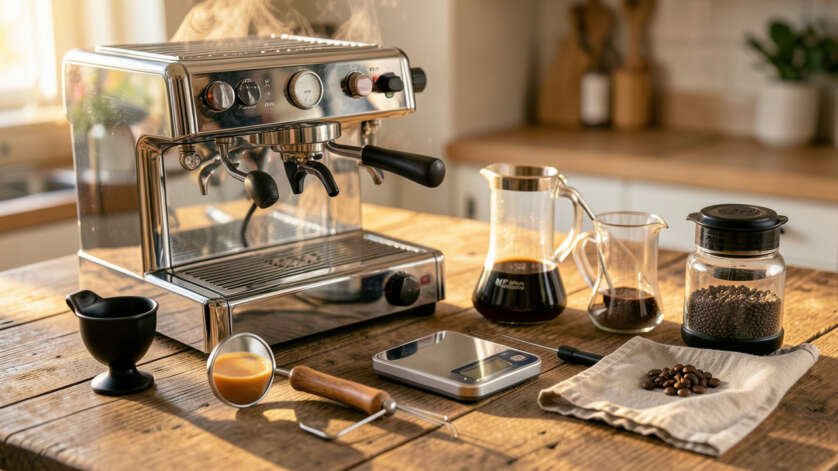
8 Ways to Improve Your Home Espresso Taste
Start with Fresh, Quality Coffee Beans
The most important step for better espresso is using good beans. Coffee is like any food; it tastes best when it’s fresh. Look for beans that have a “roasted on” date, not just a “best by” date.
Ideally, you want to use beans within a few weeks of roasting. Different beans have different flavors. Some are fruity, others are chocolatey.
Experiment to find what you like best.
Buying whole beans is also key. Pre-ground coffee loses its flavor much faster because more air can get to it. Store your beans in an airtight container, away from light and heat.
Don’t store them in the fridge or freezer, as this can add moisture and unwanted flavors.
Grind Your Beans Just Before Brewing
This is one of the biggest secrets to amazing espresso. Coffee starts to lose its flavor the moment it’s ground. Grinding your beans right before you pull a shot means you’re using the freshest possible coffee grounds.
This keeps all those wonderful aromas and flavors locked in until they hit the hot water.
You’ll need a good grinder for this. A burr grinder is much better than a blade grinder. Burr grinders give you a consistent grind size, which is super important for espresso.
A blade grinder chops the beans unevenly, leading to some parts over-extracting (bitter) and others under-extracting (sour).
Choosing the Right Grind Size
The grind size for espresso is very fine, like table salt or slightly finer. If the grind is too coarse, water will flow through too fast, and your espresso will be weak and sour. If it’s too fine, water will struggle to get through, making your espresso bitter and over-extracted.
It takes some practice to get this right. You’ll need to adjust your grinder based on your beans and your machine. As you make espresso, watch the flow.
A good shot should start to drip after a few seconds and run for about 25-30 seconds.
Get Your Water Temperature Right
Water temperature is crucial for extracting the right flavors from your coffee. The ideal temperature for espresso is usually between 195°F and 205°F (90°C to 96°C). If the water is too hot, it can burn the coffee grounds, making your espresso taste bitter and harsh.
If the water is too cool, it won’t extract enough flavor, and your espresso will taste sour and weak. Most home espresso machines heat the water automatically. However, if you have an older machine or are using a manual method, you might need to monitor the temperature.
Letting your machine heat up fully before brewing is always a good idea.
Master the Art of Tamping
Tamping is pressing the coffee grounds evenly into the portafilter basket. This creates a dense, level puck of coffee. A good tamp ensures that water flows through the grounds evenly, which is essential for balanced extraction.
Uneven tamping can lead to “channeling,” where water finds paths of least resistance, resulting in poor flavor.
You don’t need to use a lot of force, but you do need to be consistent. Aim for firm pressure, about 30 pounds of force. The goal is a level, smooth surface.
After tamping, give the portafilter a gentle tap on the counter to settle the grounds, then use your finger to sweep away any loose grounds from the rim.
Pull the Perfect Espresso Shot
Pulling a shot is the process of brewing espresso. The goal is to get the right amount of espresso in a specific amount of time. A standard double shot is usually around 18-20 grams of dry coffee grounds, producing about 36-40 grams of liquid espresso.
This should take about 25 to 30 seconds from the moment you flip the brew switch.
Watch the flow of the espresso. It should start as a dark, syrupy stream, then lighten in color as it finishes. If it flows too fast, your grind might be too coarse, or you didn’t tamp enough.
If it drips too slowly or not at all, your grind might be too fine, or you tamped too hard. Adjust your grind size for the next shot.
Clean Your Espresso Machine Regularly
Coffee oils build up over time inside your espresso machine. These oils can go rancid and make your espresso taste bitter and stale. Regular cleaning is vital for maintaining good flavor and the lifespan of your machine.
After each use, rinse your portafilter and group head. Backflushing your machine with a cleaning solution should be done weekly or every couple of weeks, depending on how often you use it. Descaling your machine to remove mineral buildup from water is also important, especially if you have hard water.
Use Filtered Water
The water you use for your espresso makes up about 98% of your final cup. Tap water can contain minerals and chemicals that affect the taste of your coffee. These can make your espresso taste off, either too bitter or too bland.
Using filtered water helps ensure a clean, pure taste. It also prevents mineral buildup inside your espresso machine, which can cause damage and affect performance over time. Simple water filters, like those used for drinking water, can make a big difference.
Dial In Your Dose and Yield
“Dialing in” means finding the perfect combination of coffee dose (how much ground coffee you use) and yield (how much liquid espresso you get) for your specific beans and machine. This is a bit like finding the sweet spot for flavor.
Start with a recommended dose for your portafilter basket (e.g., 18 grams for a double). Then, aim for a yield that’s about twice the weight of your coffee dose (e.g., 36 grams of espresso). Adjust the grind size to achieve this within 25-30 seconds.
If you’re getting too little espresso in that time, try a coarser grind. If you’re getting too much, try a finer grind. Keep adjusting until the taste is balanced – not too sour and not too bitter.
Frequently Asked Questions
Question: How often should I buy new coffee beans?
Answer: It’s best to buy beans that have a “roasted on” date and use them within 2-4 weeks of that date for the freshest taste.
Question: Can I use pre-ground coffee for espresso?
Answer: While you can, it’s not recommended for the best taste. Pre-ground coffee loses flavor quickly. Whole beans ground right before brewing are ideal.
Question: What is “channeling” in espresso?
Answer: Channeling happens when water finds an easy path through the coffee puck, causing uneven extraction and poor flavor. It’s often caused by uneven tamping or inconsistent grind size.
Question: How do I know if my espresso is over-extracted or under-extracted?
Answer: Over-extracted espresso tastes bitter and burnt. Under-extracted espresso tastes sour and weak. Finding the balance between these is key.
Question: Is it worth buying a special grinder for espresso?
Answer: Yes, a quality burr grinder is one of the most important tools for improving home espresso taste. It provides the consistent grind size needed for proper extraction.
Final Thoughts
Making delicious espresso at home is totally achievable. By focusing on fresh, quality beans and grinding them right before you brew, you’re already on the right path. Getting your water temperature, tamping, and shot timing just right will make an even bigger difference.
Don’t forget that regular cleaning keeps your machine working well and your coffee tasting pure. Small changes can lead to huge improvements in flavor. So, keep practicing and enjoying your home-brewed espresso!

![How to Inspect Your Roof Safely From Ground[1]](https://creativehouseblog.com/wp-content/uploads/2026/05/How_to_Inspect_Your_Roof_Safely_From_Ground1-768x403.jpg)
![Air Fryer Temperature Guide Explained Simply[1]](https://creativehouseblog.com/wp-content/uploads/2026/03/Air_Fryer_Temperature_Guide_Explained_Simply1-768x448.jpg)
![How Air Fryer Heating Elements Work[1]](https://creativehouseblog.com/wp-content/uploads/2026/03/How_Air_Fryer_Heating_Elements_Work1-768x448.jpg)
![Air Fryer Safety Features Explained For Beginners[1]](https://creativehouseblog.com/wp-content/uploads/2026/03/Air_Fryer_Safety_Features_Explained_For_Beginners1-768x448.jpg)
![7 Ways To Use A Milk Frother Beyond Coffee[1]](https://creativehouseblog.com/wp-content/uploads/2026/04/7_Ways_To_Use_A_Milk_Frother_Beyond_Coffee1-768x448.jpg)
![Induction vs Electric Stoves A Simple Guide[1]](https://creativehouseblog.com/wp-content/uploads/2026/03/Induction_vs_Electric_Stoves_A_Simple_Guide1-768x448.jpg)