Extension lead safety mistakes at home frequently include overloading electrical outlets, using cords with incorrect ratings for connected devices, or ignoring damage such as fraying, kinks, or exposed wires. These errors substantially increase risks of electrical fires, equipment failure, or shocks, highlighting the importance of regular inspection and proper usage. To prevent such issues, always match cord capacity to appliance needs, never daisy-chain multiple extensions, and store cords in well-ventilated, dry areas away from potential hazards.
Many people use extension cords every day without giving them much thought, which is why Extension Lead Safety Mistakes People Make at Home are so common.
It is easy for beginners to overlook simple safety rules when plugging things in. This post will help you spot these common errors and fix them.
We will show you easy ways to keep your home safe. Get ready to learn some simple tips that make a big difference.
Key Takeaways
- Learn the most common ways people misuse extension cords.
- Understand why overloading extension cords is dangerous.
- Discover the risks of using damaged or old extension cords.
- Find out the right way to connect and store extension leads.
- See how to pick the best extension cord for your needs.
- Know when to replace an extension cord instead of repairing it.
![Extension Lead Safety Mistakes People Make at Home[1]](https://creativehouseblog.com/wp-content/uploads/2026/05/Extension_Lead_Safety_Mistakes_People_Make_at_Home1.jpg)
Common Extension Lead Safety Mistakes at Home
Extension cords seem pretty straightforward, but small mistakes can lead to big problems. Many people don’t realize they are using their extension leads unsafely. This section covers the most frequent errors people make.
Knowing these can help you avoid dangerous situations right away.
Using the Wrong Type of Extension Cord
Extension cords are not all the same. They come in different strengths and are made for different uses. Using a light-duty cord for a heavy appliance is a common mistake.
Heavy-duty cords have thicker wires inside. These wires can carry more electricity safely. A thin wire can get hot when too much power flows through it.
This heat can melt the plastic cover. It can even start a fire. Always check the cord’s label to see what it is rated for.
For example, a fan might only need a cord rated for 10 amps. A microwave or a space heater needs a cord rated for 15 amps or more. Using the wrong cord is like trying to push too much water through a tiny straw.
It just won’t work well and can cause damage. You should also consider where you will use the cord. Some cords are made for indoor use only.
Others are built to be tough and can handle outdoor weather.
What to Look For
- Amperage Rating: This tells you how much electricity the cord can handle. Match it to your appliance.
- Voltage Rating: Most cords are for 125 volts, but check if you have higher voltage devices.
- Indoor vs. Outdoor Use: Outdoor cords are made to resist water, dirt, and sunlight.
- Cord Length: Get a cord that is long enough but not excessively long, as long cords can be a tripping hazard.
A study by the National Fire Protection Association (NFPA) found that about 3,000 home fires each year are caused by electrical wiring or equipment.
Extension cords are a part of this. Many of these fires start because the wrong type of cord was used or the cord was damaged.
Overloading Extension Cords
This is one of the most dangerous Extension Lead Safety Mistakes People Make at Home. Plugging too many devices into one extension cord, or plugging in devices that use too much power, can cause problems. Every extension cord has a limit on how much power it can safely deliver.
This is called its wattage or amperage rating.
When you plug in devices, they draw power from the cord. If the total power drawn by all the devices is more than the cord can handle, the cord can overheat. The wires inside can get very hot, melt their insulation, and start a fire.
Think of it like trying to fill a bucket with a fire hose. Too much water will spill over the sides.
Example Scenario
- You have an extension cord rated for 10 amps.
- You plug in a computer that uses 2 amps.
- You also plug in a lamp that uses 1 amp.
- Then, you plug in a fan that uses 3 amps.
- The total power being used is 2 + 1 + 3 = 6 amps. This is okay because it’s less than 10 amps.
- However, if you then plug in a space heater that uses 8 amps, the total becomes 6 + 8 = 14 amps. This is too much for the 10-amp cord and can be dangerous.
It is very important to check the power needs of your appliances. You can usually find this information on a label on the appliance itself or in its manual. Look for numbers measured in amps (A) or watts (W).
If you need to power many devices or high-power ones, you might need more than one outlet, or a heavy-duty extension cord.
A power strip with a built-in surge protector can be a safer option for multiple low-power devices, but still has limits.
According to the U.S. Fire Administration, electrical distribution or lighting equipment, including extension cords, is a leading cause of reported home fires. About 11% of these fires are caused by extension cords.
Damaged or Worn-Out Extension Cords
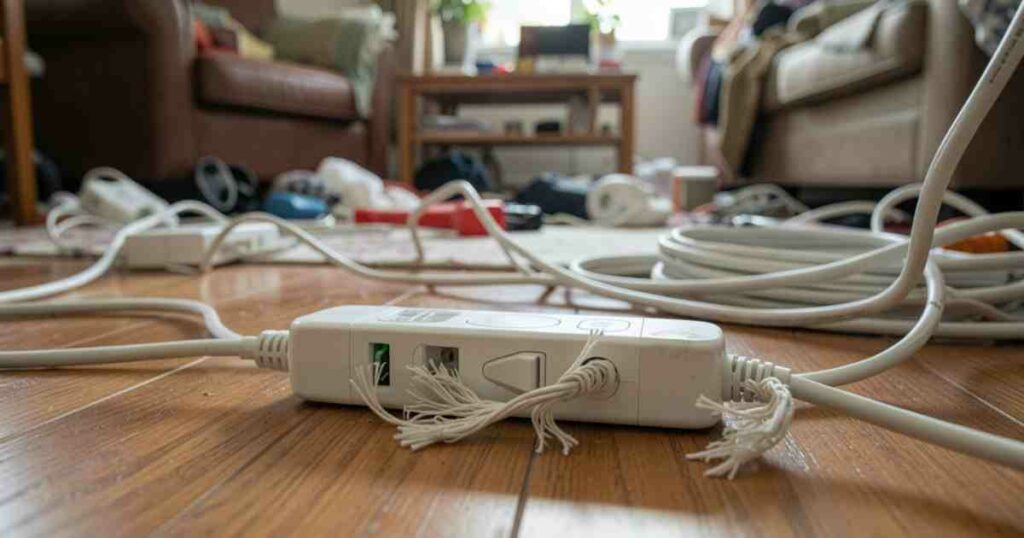
Using extension cords that are old, frayed, or have damaged plugs is a serious safety risk. The plastic casing can get cracks or tears, exposing the wires inside. Frayed wires are a fire hazard and can also give you an electric shock.
A damaged plug might not connect properly to the outlet, leading to sparks.
It is easy to ignore a small cut in the plastic, but even a tiny bit of exposed wire can be dangerous.
If the damaged part touches something metal or if your hand touches it, you could get a shock. If it touches flammable material like curtains or carpet, it could easily start a fire.
Worn-out cords often have loose connections. This can cause them to get hotter than they should, even if not overloaded.
Visual Signs of Damage to Watch For
- Cracked or Frayed Casing: The outer plastic covering is split or worn thin.
- Exposed Wires: You can see the metal wires inside the cord.
- Bent or Broken Plug Pins: The prongs that go into the wall outlet are damaged.
- Worn-Out Connectors: The female end where you plug in an appliance is loose or damaged.
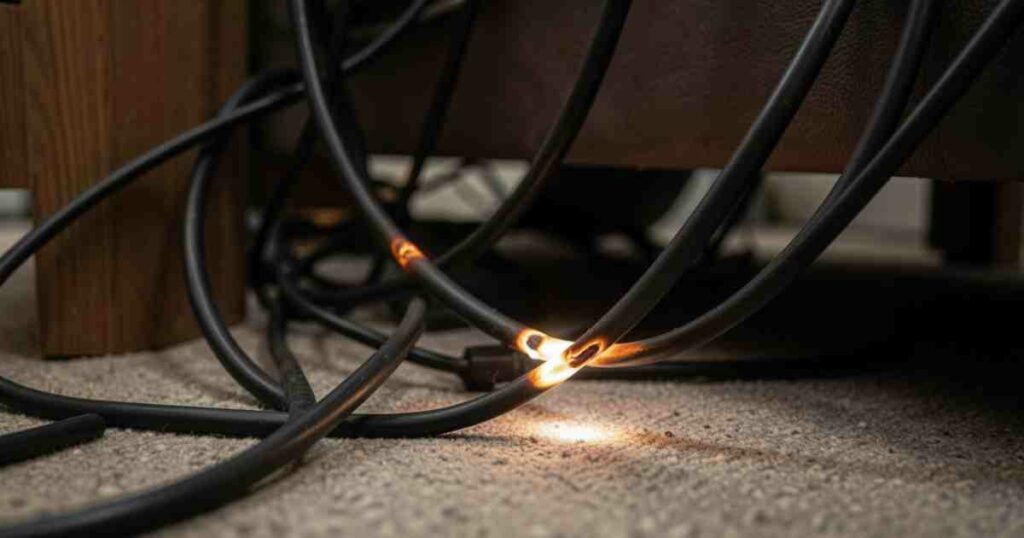
- Signs of Melting or Discoloration: The plastic looks warped or has dark spots, often from overheating.
A damaged cord is one of the most common causes of electrical fires. It is always better to be safe. If you find a damaged extension cord, do not try to fix it with tape.
It might seem like a quick fix, but it is not safe. The tape can fall off, and the underlying damage remains. The safest action is to throw the cord away and buy a new one.
When inspecting your cords, do it regularly, especially if they are used often or are several years old.
Improper Placement and Use
Where and how you use an extension cord matters a lot. Common mistakes include running them under carpets, through doorways, or in wet areas. These actions can damage the cord and create hidden dangers.
Running a cord under a carpet hides it from view. You might not notice if it gets damaged. Also, carpets can trap heat.
This can cause the cord to overheat. People might also step on the cord repeatedly, which can cause wear and tear. If the cord is damaged, the hidden wires can be a fire risk.
Placing cords through doorways is also risky. Every time the door is opened or closed, it can pinch the cord. This can damage the wire inside.
It’s also a tripping hazard for people walking through the door.
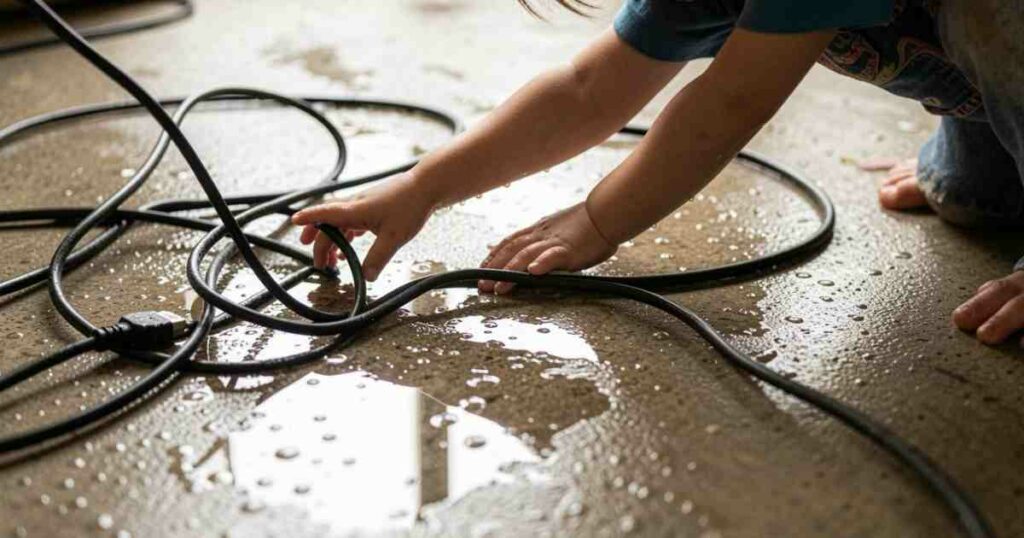
Using indoor extension cords outdoors or in damp areas is another big mistake. These cords are not built to withstand moisture or outdoor conditions. Water and electricity are a dangerous mix.
It can lead to electric shocks or short circuits that cause fires.
Safe Placement Tips
- Keep Cords Visible: Always ensure extension cords are in plain sight.
- Avoid High-Traffic Areas: Do not run cords across floors where people walk often.
- Never Run Under Rugs or Furniture: This hides damage and traps heat.
- Keep Away from Water Sources: Never use indoor cords near sinks, showers, or in wet conditions.
- Secure Cords When Necessary: Use cord clips or covers to keep them in place and prevent tripping hazards, but do not let them get damaged by being pinched.
The Consumer Product Safety Commission (CPSC) has warned about the dangers of extension cords hidden under carpets. Fires have been reported from cords that were damaged in this way.
Extension Lead Safety Mistakes People Make at Home When Storing Them
Proper storage is just as important as safe usage. Storing extension cords incorrectly can lead to damage that you might not notice until the cord is used again. This section looks at common storage errors and how to avoid them.
Coiling Cords Too Tightly
When you coil an extension cord, it's important not to make the loops too small. Tightly coiling a cord, especially for long periods, can bend the wires inside too sharply. Over time, these sharp bends can weaken the wires.
This can lead to internal breaks or damage to the insulation.
Imagine bending a paperclip back and forth many times. Eventually, it will break. The wires inside an extension cord can suffer a similar fate if bent too sharply repeatedly.
This damage is often invisible from the outside. When you use the cord later, it might short out, overheat, or not work at all. It’s best to coil cords loosely, making large, gentle loops.
Leaving Cords Plugged In or Exposed
Many people leave extension cords plugged into the wall outlet even when they are not in use. While this might seem convenient, it can pose risks. The plug itself can be a tripping hazard.
If the cord is left lying around, it can be accidentally stepped on or damaged. Leaving a cord plugged in also means it is exposed to dust and moisture, which can degrade the plug and socket over time.
Furthermore, some older homes may have faulty outlets. Leaving a cord plugged in could expose it to issues with the wall outlet itself. It is a good practice to unplug extension cords when they are not actively being used.
This reduces wear and tear on both the cord and the outlet. It also eliminates a potential tripping hazard and keeps the cord clean and safe.
Storing in Damp or Unsuitable Locations
Extension cords should be stored in a dry place. Attics, basements, or garages can sometimes be damp. Moisture can seep into the plastic casing and connectors of the cord.
Over time, this can cause corrosion on the metal parts and damage the insulation.
If the cord’s insulation is damaged, it makes it more likely to short circuit or cause an electric shock.
Storing cords near chemicals or solvents can also be dangerous. Some chemicals can eat away at the plastic, weakening the cord.
A cool, dry place like a closet or a toolbox is usually the best option for storing extension cords when they are not needed.
Extension Lead Safety Mistakes People Make at Home When Connecting Them
The way an extension cord connects to both the wall outlet and the appliance is critical. Mistakes here can be incredibly dangerous. Let’s explore some common connection errors.
Loose Connections
A loose connection at either the wall outlet or the appliance plug can cause problems. If the extension cord’s plug is not pushed all the way into the wall outlet, or if the appliance plug is not fully inserted into the extension cord, it can create a poor connection. This poor connection means the electricity might not flow smoothly.
This often leads to arcing, which is like tiny electrical sparks jumping across the gap. Arcing generates a lot of heat. This heat can melt the plastic around the plug and socket.
It can also ignite nearby flammable materials, starting a fire. A loose connection is also less efficient. Your appliance might not get the full power it needs to work correctly.
Signs of a Loose Connection
- The plug wiggles easily in the outlet or socket.
- You hear or see sparks when plugging in or unplugging.
- The plug or socket feels unusually warm to the touch.
- The appliance loses power intermittently.
It’s vital to ensure that all plugs are firmly seated. Push them in until they feel secure. If an outlet or plug feels loose, do not use that extension cord or outlet.
You might need to have an electrician check your home’s wiring or replace the faulty outlet or cord.
Never force a plug into a socket if it doesn’t fit easily; it might be the wrong type or the socket could be damaged.
Using Adapters (Cheater Plugs) Improperly
Sometimes people use adapters, often called "cheater plugs," to connect a three-prong plug to a two-prong outlet.
These adapters are often used with older homes that may not have grounded outlets. While these adapters can be useful, they must be used correctly to maintain safety.
The third prong on a plug is a ground wire. This wire is a safety feature. If there is an electrical fault within an appliance, the ground wire provides a safe path for the electricity to flow into the ground instead of through a person.
When you use a two-prong adapter, you bypass this safety feature if the adapter is not properly grounded itself.
A common mistake is to simply plug the adapter into the two-prong outlet and then plug the appliance’s three-prong plug into the adapter.
However, many of these adapters have a small metal tab or wire that is meant to be screwed to the metal cover plate of the outlet. This provides the grounding connection.
If this tab is not connected, the appliance is no longer grounded, and the safety benefit is lost.
Correct Use of a Grounding Adapter
- Ensure the adapter is designed for grounding.
- Plug the adapter into the two-prong wall outlet.
- Locate the small metal tab or wire on the adapter.
- Unscrew the screw holding the wall outlet’s cover plate slightly.
- Place the adapter’s metal tab under the screw head.
- Tighten the screw to secure the adapter’s ground wire to the outlet’s metal box.
- Plug the appliance’s three-prong plug into the adapter.
If you are unsure about using these adapters or if your home has many ungrounded outlets, it is best to consult a qualified electrician. They can advise on updating your home’s wiring for better safety.
Connecting Extension Cords Together
It’s tempting to link multiple extension cords together to reach a distant outlet. However, this is one of the most significant Extension Lead Safety Mistakes People Make at Home. Connecting extension cords in series is dangerous for several reasons.
Each connection point adds resistance. This resistance creates heat. The more connections, the more heat is generated.
This dramatically increases the risk of overheating and fire. Also, each connection point is a potential weak spot. It can become loose over time, leading to arcing and further heat buildup.
The overall length of the combined cords can also make them sag or become a tripping hazard.
If you need a longer cord, it is always better to buy a single, longer extension cord. Ensure it is rated for the power needs of your appliance. Extension cords are designed to be used individually.
They are not meant to be chained together to extend reach. This practice overloads the system and compromises safety.
Extension Lead Safety Mistakes People Make at Home with Maintenance
Proper maintenance ensures that your extension cords remain safe to use over time. Neglecting maintenance can lead to hidden dangers. Here are some common maintenance mistakes.
Ignoring Regular Inspection
Extension cords need to be checked regularly, just like any other electrical equipment. Many people use their cords for months or even years without ever looking closely at them. This means they might not notice damage like frays, cuts, or overheating marks until it’s too late.
A quick inspection before each use can prevent many accidents. Look for any signs of wear and tear on the cord itself, the plugs, and the sockets. Check if the cord is still flexible or if it has become stiff and brittle.
Also, ensure the plugs are firm and not loose. If you find any issues, it is best to replace the cord immediately.
Inspection Checklist
- Is the cord casing cracked, cut, or frayed?
- Are the wires visible anywhere along the cord?
- Are the plug pins bent or damaged?
- Is the female end of the cord loose or damaged?
- Are there any signs of melting or discoloration on the cord or plugs?
This simple habit of regular inspection is a key part of preventing fires and shocks. It takes only a minute but can save a lot of trouble.
Attempting DIY Repairs
When an extension cord gets damaged, some people try to fix it themselves using tape. While tape might hold a frayed cover together temporarily, it is not a safe repair for electrical cords.
Electrical tape is designed to insulate, but it’s not a substitute for the cord’s original protective casing.
The damage underneath the tape is still there. The wires might still be exposed or weakened. The tape can also become loose over time, especially if the cord heats up.
This can leave the wires exposed again. A properly repaired extension cord is often more expensive than buying a new one. Therefore, for safety reasons, it is always better to replace a damaged extension cord.
Why DIY Repairs Are Risky
- Inadequate Insulation: Regular tape or even some electrical tapes are not designed for the continuous heat and flexing of an extension cord.
- Hidden Damage: Tape hides underlying problems like internal wire damage or insulation wear.
- Temporary Fix: The repair is often short-lived and can fail unexpectedly.
- Fire Hazard: Exposed wires or overheating due to a poor repair can easily start a fire.
Professional repair services for extension cords are rarely available or cost-effective for consumer-grade cords. Replacing a damaged cord is the safest and most practical solution.
Choosing the Right Extension Cord
Selecting the correct extension cord from the start is a vital step in avoiding dangerous Extension Lead Safety Mistakes People Make at Home.
With so many options available, it’s easy to pick the wrong one if you’re not careful. This section helps you make the best choice.
Understanding Wattage and Amperage Ratings
Extension cords are rated by how much electrical current (amperage or amps) or power (wattage or watts) they can handle.
This is perhaps the most critical specification. You must match the cord’s rating to the appliance you intend to plug into it.
Amperage (A): This measures the rate of electrical current flow. Higher amperage means the cord can carry more electricity. Wattage (W): This is the rate at which electrical energy is transferred.
It’s calculated as Volts x Amps (W = V x A). Most household outlets are 120 volts.
For example, if a toaster uses 10 amps, and your wall outlet is 120 volts, it uses 10 amps x 120 volts = 1200 watts.
If your extension cord is rated for only 7 amps (about 840 watts), it will likely overheat when powering the toaster.
Typical Appliance Power Needs
| Appliance | Typical Amperage (A) | Typical Wattage (W) |
|---|---|---|
| Lamp | 0.5 – 2 A | 60 – 240 W |
| Laptop Charger | 1 – 2 A | 120 – 240 W |
| Fan | 1 – 3 A | 120 – 360 W |
| Vacuum Cleaner | 8 – 12 A | 960 – 1440 W |
| Space Heater | 10 – 15 A | 1200 – 1800 W |
Always choose an extension cord with a rating that is at least 20% higher than the appliance’s requirement.
This provides a safety margin. For heavy-duty tools or appliances, use a heavy-duty extension cord specifically designed for them.
Considering Cord Length and Gauge
The length of an extension cord affects its resistance and voltage drop. Resistance is the opposition to the flow of electricity. Longer cords have more resistance.
A longer cord might cause the voltage supplied to the appliance to drop, meaning the appliance might not work as efficiently or powerfully.
Gauge refers to the thickness of the wire inside the cord. It’s measured by the American Wire Gauge (AWG) system. A lower AWG number means a thicker wire.
Thicker wires have less resistance and can carry more current safely. For example, a 14-gauge cord is thicker than an 18-gauge cord.
Choosing the Right Gauge for Length
- 18-gauge: Best for very short runs (under 25 feet) and low-power devices (like lamps or clocks).
- 16-gauge: Suitable for medium lengths (up to 50 feet) and moderate power needs (like fans or holiday lights).
- 14-gauge: Needed for longer runs (up to 100 feet) or higher-power devices (like power tools or larger appliances).
- 12-gauge: Used for very high-power needs or very long runs, often for heavy-duty equipment.
Using a cord that is too long and too thin for the appliance is a common mistake. It can lead to overheating and reduced performance. Always choose a gauge that is appropriate for both the length and the power requirements.
Indoor vs. Outdoor Cords
Using the wrong cord in the wrong environment is a frequent error. Extension cords are specifically designed for either indoor or outdoor use. They look similar, but their construction and materials differ significantly.
Indoor cords are typically made with simpler insulation and casing materials. They are not designed to withstand exposure to sunlight (UV rays), moisture, temperature extremes, or physical abrasion.
Using an indoor cord outdoors can cause the casing to become brittle, crack, and degrade rapidly.
This exposes the internal wires.
Outdoor cords are built to be more durable. They have tougher, weather-resistant insulation and casings. They are designed to resist moisture, dirt, oil, and UV light.
They also often have reinforced connectors to protect them from the elements and physical stress.
Look for markings like “Outdoor Use,” “Wet Location,” or “All-Weather” on the packaging or cord itself.
Using an outdoor cord indoors is generally safe, but it might be more expensive or bulkier than necessary.
The key is to never use an indoor-rated cord outside. This mistake can lead to premature cord failure and significant safety hazards.
Frequently Asked Questions Of Extension Lead Safety Mistakes People Make at Home
Question: Can I use an extension cord permanently
Answer: No, extension cords are designed for temporary use only. They are not a safe substitute for permanent wiring in your home. Using them permanently can lead to overheating, damage, and fire hazards.
Question: What happens if I plug a high-wattage device into a low-wattage extension cord
Answer: If you plug a high-wattage device into a low-wattage extension cord, the cord can overheat. This is because the cord cannot safely handle the amount of electricity being drawn. Overheating can melt the cord’s insulation and potentially start a fire.
Question: Is it safe to run extension cords under rugs
Answer: No, it is never safe to run extension cords under rugs or carpets. This practice hides potential damage to the cord, makes it prone to overheating, and increases the risk of fire. It also creates a tripping hazard.
Question: How often should I inspect my extension cords
Answer: You should inspect your extension cords regularly, ideally before each use. Look for any signs of damage such as cuts, fraying, cracked insulation, or damaged plugs. If you find any damage, replace the cord immediately.
Question: Can I connect two extension cords together to make them longer
Answer: No, you should never connect two extension cords together. This creates a weak point, increases the risk of overheating, and can lead to fires. If you need a longer cord, purchase a single, longer extension cord that meets your needs.
Summary
Avoiding Extension Lead Safety Mistakes People Make at Home is key to a safe living space.
Always choose the right cord for the job, avoiding overloading and never using damaged cords. Store them properly and connect them securely.
Regular checks and correct selection prevent fires and shocks. Your home’s safety depends on these simple steps.

![How to Use a Rice Cooker Properly[1]](https://creativehouseblog.com/wp-content/uploads/2026/03/How_to_Use_a_Rice_Cooker_Properly1-768x448.jpg)
![10 Foods You Should Never Store In A Freezer[1]](https://creativehouseblog.com/wp-content/uploads/2026/04/10_Foods_You_Should_Never_Store_In_A_Freezer1-768x448.jpg)
![How Slow Cooking Works Explained Simply[1]](https://creativehouseblog.com/wp-content/uploads/2026/03/How_Slow_Cooking_Works_Explained_Simply1-768x448.jpg)
![How to Protect Pipes From Freezing in Winter[1]](https://creativehouseblog.com/wp-content/uploads/2026/05/How_to_Protect_Pipes_From_Freezing_in_Winter1-768x403.jpg)
![7 Mistakes People Make When Using Indoor Electric Grills[1]](https://creativehouseblog.com/wp-content/uploads/2026/04/7_Mistakes_People_Make_When_Using_Indoor_Electric_Grills1-768x448.jpg)